Travel information Peru for motorcycle tours

What to sort out before setting off for Peru: visa and import of your own motorcycle, SOAT insurance, Andean pass altitudes and tracks in the Amazon lowlands.

One more question about Peru?

Visa, entry, season or route – in the live chat we usually reply within 3 minutes.

The essentials on Peru at a glance

Updated: August 2026

Visa
Visa-free, entry stamp usually 90 days
Official maximum 183 days/year; since 2023, extension within the country is practically only for citizens of the Andean Community (Bolivia, Colombia, Ecuador)
Passport
Valid for at least 6 months from entry, at least 2 blank pages
Best season
Andes/Cusco region: May to September; Amazon lowlands: driest June to September
Currency
Peruvian Sol (PEN); cash needed nationwide, cards only in cities
Time zone
UTC-5, no daylight saving time year-round
Traffic
Right-hand traffic
Helmet & gear
Helmets compulsory for rider and passenger
Main route
Panamericana (coast) and Interoceánica Sur (Cusco-Puerto Maldonado) paved; mountain roads often narrow and winding
Fuel
Unleaded 90 and 97 octane widespread, 84 octane regionally in the Amazon lowlands (including Madre de Dios)
Intl. driving permit
International Driving Permit recognised under either the 1949 Geneva Convention or the 1968 Vienna Convention; carry it alongside your national licence

Entry

Visa and entry to Peru

German, Austrian and Swiss nationals enter visa-free - the length of stay is set at entry, not granted automatically.

Tourist entry (visa-free)

Stay
usually 90 days (stamped on entry), legal maximum 183 days/year
Cost
free
Where to apply
Border crossing / airport
Validity
until the stamped departure date

Extension of tourist status (within Peru)

Stay
since 2023 only for the Andean Community (Bolivia, Colombia, Ecuador), not for EU citizens
Cost
-
Where to apply
Migraciones
Validity
not applicable for EU citizens

Temporary import of your own motorcycle (TIP)

Stay
10 to 90 days, tied to tourist status, not extendable without a stay extension
Cost
free
Where to apply
Customs (SUNAT) at the border crossing
Validity
until the end of the tourist stay

Your own bike

Importing your own motorcycle

No Carnet de Passages needed - like all of South America, Peru only requires temporary import at the border, plus short-term SOAT insurance and clean vehicle papers.

Checklist for the border

  • Original vehicle registration document
  • Passport with at least 6 months of remaining validity
  • National driving licence plus international driving permit (1949 or 1968)
  • Buy short-term SOAT insurance at the border crossing and verify it online (soat.com.pe)
  • For a vehicle not your own: notarised, translated and apostilled power of attorney from the owner
  • Check that the temporary import (SUNAT) and the passport entry stamp share the same end date
  • Before leaving: have the vehicle checked out again with customs, or the import stays open

The motorcycle's temporary import never runs longer than your own tourist status - and since 2023 that can practically no longer be extended within Peru for EU citizens. Anyone wanting to stay longer has to leave and re-enter before both deadlines expire.

Documents

Driving licence and checkpoints

Peru recognises the International Driving Permit under both the Geneva (1949) and Vienna (1968) conventions - it doesn't replace your national licence, only supplements it.

  • National driving licence (original)
  • International Driving Permit under the 1949 Geneva Convention or the 1968 Vienna Convention
  • Vehicle registration document
  • Proof of temporary import (SUNAT)
  • Short-term SOAT insurance certificate

Season

Best time for motorcycle tours

The Andes and the Amazon follow opposite calendars - the dry season in Cusco is not the dry season in the rainforest.

Best season: May to September (Andean dry season)

Rideability by month and region
Region Jan Feb Mar Apr May Jun Jul Aug Sep Oct Nov Dec
Andes / Cusco region Jan: Not rideable Feb: Not rideable Mar: Not rideable Apr: Rideable, with limits May: Best riding window Jun: Best riding window Jul: Best riding window Aug: Best riding window Sep: Best riding window Oct: Rideable, with limits Nov: Rideable, with limits Dec: Not rideable
Amazon lowlands / rainforest (Madre de Dios) Jan: Not rideable Feb: Not rideable Mar: Not rideable Apr: Not rideable May: Rideable, with limits Jun: Best riding window Jul: Best riding window Aug: Best riding window Sep: Best riding window Oct: Rideable, with limits Nov: Not rideable Dec: Not rideable
  • Best riding window
  • Rideable, with limits
  • Not rideable
In the Cusco region, dry and passable from May to September; in the Amazon lowlands, rainfall is lowest from June to September - the two regions run slightly out of step.
Matching departures in Peru The best window is May to September (Andean dry season). See the tours that start within it. Tours in Peru

Roads & tracks

Road conditions and mountain passes

Two very different worlds of road: paved high-mountain passes around Cusco and unpaved tracks on the way down into the Amazon lowlands.

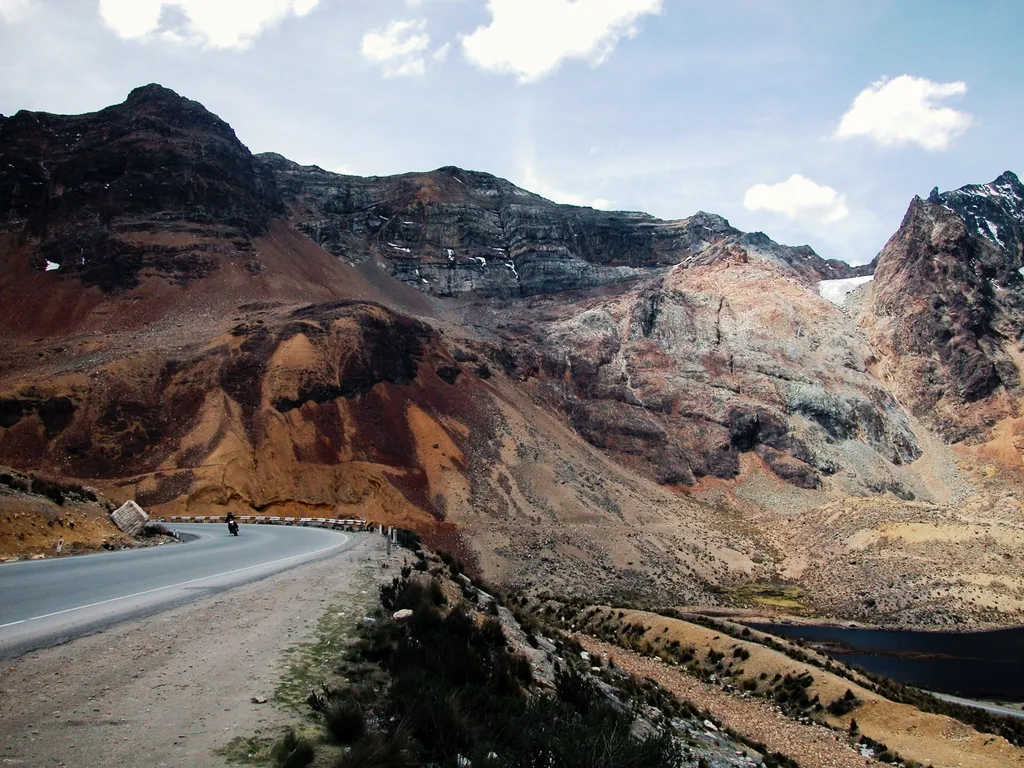
Abra Málaga (Ollantaytambo-Santa María, Ruta 28B, Cusco region)

121 km

100 % Paved

Condition
Paved throughout, very winding, numerous hairpin bends up to the pass
After rain
Fog and black ice near the pass, occasional rockfall on the steep sections
Daily distance
80 to 120 km (noticeably slower than map kilometres, due to curves and altitude)
Fuel
Fuel stations only in Ollantaytambo and Quillabamba, none in between
Passes & altitude
Abra Málaga 4343 m
Permits
none

Cusco - Paucartambo - Pilcopata - Atalaya (Manu access route, Amazon lowlands)

204 km
Condition
Paved for the first roughly two hours to Paucartambo, then mostly gravel and dirt through the cloud forest, washed out in places
After rain
Muddy and slippery after rain, with individual sections temporarily impassable
Daily distance
100 to 150 km (cloud-forest curves and road condition noticeably limit the pace)
Fuel
Last guaranteed fuel station in Paucartambo, after that only scattered canister sales in villages
Passes & altitude
Tres Cruces viewpoint above Paucartambo, approx. 3700 m
Permits
none, checkpoint at Salvación at the entrance to Manu National Park

Fuel

Fuel and filling up in Peru

Regular petrol is available everywhere, but the octane rating changes from region to region - and in the Amazon lowlands, paying cash is the rule.

Gasohol 84

Availability
Amazon lowlands (including Madre de Dios), often the only option away from cities

Gasohol 90

Availability
standard nationwide

Gasohol 95 / 97

Availability
larger cities and the Panamericana

Diesel B5

Availability
widespread nationwide, generally irrelevant for motorcycles

Safety

Safety and emergency calls

Peru's emergency numbers are split by service - a unified 911 system is still being built.

Emergency numbers

Health

Health and altitude risk

Cusco sits at 3400 m, and the passes on the tours go even higher - altitude adjustment belongs in your schedule, not just your packing list.

  • Get malaria/yellow fever advice before riding into the Amazon lowlands (Madre de Dios)
  • Travel medical kit with altitude sickness remedies (e.g. acetazolamide, check with a doctor)
  • Plan one to two acclimatisation days before the first pass ride above 4000 m
  • Enough drinking water and sun protection for the high altitudes
  • Mosquito protection for the Amazon lowlands

Many travel and motorcycle insurance policies exclude motorcycles over 125cc or require a separate classification - clarify this with your own insurer before setting off, not only after an accident.

Money

Money, the Sol and paying

Peru is a cash country - cards work reliably only in cities and larger tourist towns.

Cash (Sol)

Note
Essential in rural areas, at fuel stations and for SOAT/customs

Credit/debit card

Note
Lima, Cusco and larger cities; decline dynamic currency conversion (DCC) at ATMs

ATM

Note
Daily limit usually 700 to 800 Sol; prefer ATMs at banks/shopping centres

Packing list

What to add to your luggage

Only what Peru adds to the touring kit you already have - not a substitute for the basics.

  • A cold- and wind-protection layer for nights above 4000 m in the Andes
  • A spare fuel canister for the unpaved route towards Manu
  • Notarised, translated power of attorney for a vehicle that isn't your own
  • A printed copy of the temporary import document (SUNAT) within reach
  • Mosquito protection and light long clothing for the Amazon lowlands
  • A cash reserve in Sol for fuel stations without a card reader

Subscribe to World Travel News

Get the latest travel news from around the world – reports, tips and adventures. No promotional content, just real travel inspiration.

Categories of interest

Thanks for subscribing!

You'll receive a confirmation by email shortly.

Send enquiry

Tell us what you're planning – we'll get back to you personally and without obligation.

We use cookies

We use cookies to make your journey on our site as pleasant as possible. You can find details in our privacy policy.