Travel information Ireland for motorcycle tours

Everything you need to know before your Ireland tour: left-hand traffic, bringing your own motorcycle, the best season and the Wild Atlantic Way, from a rider's perspective.

One more question about Ireland?

Visa, entry, season or route – in the live chat we usually reply within 3 minutes.

The essentials on Ireland at a glance

Updated: August 2026

Visa
No visa needed (EU citizens with an ID card or passport)
Non-EU tourists visa-free for up to 90 days; Ireland is not part of the Schengen area
Passport
No minimum validity required; an EU ID card is enough
Best season
April to September, drier and less windy than winter
Currency
Euro (EUR)
Time zone
UTC+0, UTC+1 in summer
Irish Standard Time, same as the UK
Traffic
Drive on the left
Helmet & gear
Helmet compulsory; protective clothing not required by law
Main route
Motorways (M) around Dublin and Cork, otherwise N-roads; the Wild Atlantic Way follows R- and L-roads
Fuel
Unleaded 95 and diesel widely available; in the far west often closed in the evening and on Sundays
Intl. driving permit
Not required for EU/EEA licences, recognised directly

Entry

Entry & Visa Requirements for Ireland

Ireland is an EU member state but not a Schengen country. For most European travellers, entry is still straightforward.

Visa-free (EU/EEA/Switzerland)

Stay
Unlimited (free movement)
Cost
none
Where to apply
No application needed, enter with an ID card or passport
Validity
No time limit

Visa-free (non-EU tourists)

Stay
Up to 90 days
Cost
none
Where to apply
No application needed, entry stamp
Validity
90 days per stay

Own motorcycle (EU/EEA registration)

Stay
Unlimited
Cost
none
Where to apply
No customs declaration, EU single market
Validity
No time limit

Own motorcycle (non-EU registration)

Stay
Up to 24 months
Cost
none
Where to apply
Temporary use, informal
Validity
Tied to the tourist stay

Your own bike

Bringing Your Own Motorcycle to Ireland

No carnet, no customs declaration: Ireland is part of the EU single market. The real planning starts with the ferry.

Checklist for the border

  • Original vehicle registration document (Part I)
  • Valid proof of insurance; a green card is recommended as extra evidence
  • Certified authorisation from the owner, if the motorcycle isn't yours
  • If arriving via the UK: check your insurance cover with your insurer beforehand
  • Carry your card-format driving licence
  • Copies of all documents, stored separately from the originals

Before booking the ferry, check whether your motor insurance covers trips to the island of Ireland. If you're arriving via the UK, bring your green card and check your cover directly with your insurer beforehand.

Documents

Driving Licence and Documents

An EU driving licence is recognised directly. An international one only matters for non-EU licences.

  • EU Class A driving licence, card format
  • International driving permit recommended for non-EU/EEA licences
  • Passport or ID card
  • Original vehicle registration document (Part I)
  • Proof of insurance; a green card is recommended as evidence
  • Copies of everything, kept separately from the originals

Season

Best Time to Travel & Climate in Ireland

Ireland can be ridden all year round — there are no closed passes or dirt tracks. What changes is rain, wind and daylight.

Best season: April to September

Rideability by month and region
Region Jan Feb Mar Apr May Jun Jul Aug Sep Oct Nov Dec
Wild Atlantic Way / West Coast Jan: Rideable, with limits Feb: Rideable, with limits Mar: Rideable, with limits Apr: Best riding window May: Best riding window Jun: Best riding window Jul: Best riding window Aug: Best riding window Sep: Best riding window Oct: Rideable, with limits Nov: Rideable, with limits Dec: Rideable, with limits
East & Inland (Dublin, Midlands) Jan: Rideable, with limits Feb: Rideable, with limits Mar: Best riding window Apr: Best riding window May: Best riding window Jun: Best riding window Jul: Best riding window Aug: Best riding window Sep: Best riding window Oct: Best riding window Nov: Rideable, with limits Dec: Rideable, with limits
  • Best riding window
  • Rideable, with limits
  • Not rideable
April is on average the driest month, December and January the wettest. The west coast along the Wild Atlantic Way gets almost twice as much rain as the east and is noticeably windier in winter.
Matching departures in Ireland The best window is April to September. See the tours that start within it. Tours in Europe

Roads & tracks

Road Conditions & Riding in Ireland

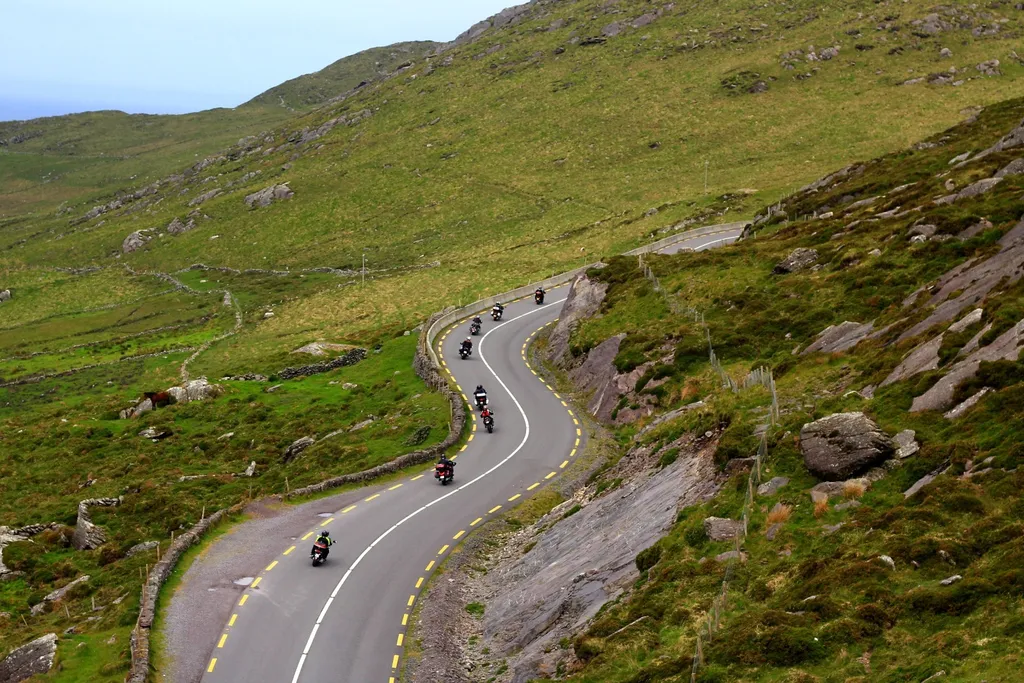
Not a metre of dirt track, but narrow country roads between stone walls and hedges — Ireland calls for attention rather than off-road experience.

Wild Atlantic Way (full coastal route, Donegal to Cork)

2.500 km

100 % Paved

Condition
Signposted route over N-, R- and L-roads, paved throughout, many tight bends and towns
After rain
No surface risk, but visibility and braking distance are noticeably reduced on narrow sections
Daily distance
150 to 200 km, depending on bends and stops
Fuel
In every larger town; often closed in the evening and on Sundays in the far west
Passes & altitude
No pronounced pass summit, a hilly coastal road
Permits
none

Ring of Kerry (N70/N71/N72, Iveragh Peninsula)

179 km

100 % Paved

Condition
Narrow, winding coastal road around the peninsula; heavy tour-coach traffic on narrow sections in summer
After rain
Stone walls along the roadside leave no room to pull over; a wet surface calls for more distance in the bends
Daily distance
179 km as a usual day trip; a full day with stops
Fuel
Killarney, Killorglin, Kenmare, Waterville
Passes & altitude
no pronounced pass summit
Permits
none

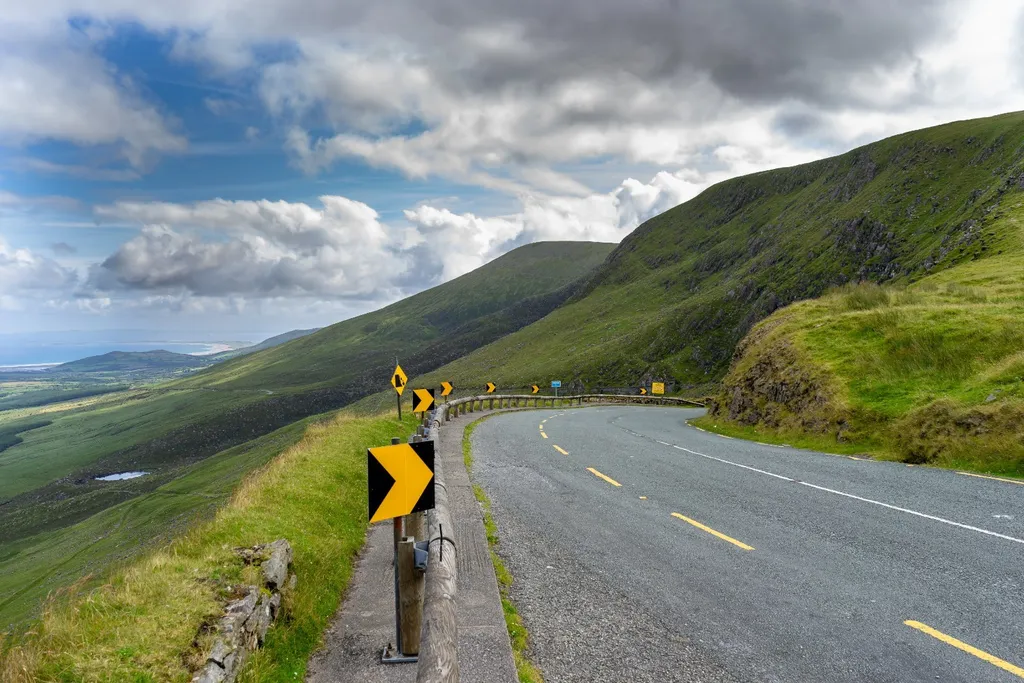
Conor Pass (R560, Dingle Peninsula)

100 % Paved

Condition
Single-track paved road, oncoming traffic must reverse to a passing point; vehicles over 2 tonnes are prohibited
After rain
Fog and low cloud are common at the summit; visibility can drop sharply
Daily distance
Short stretch, suitable as a side trip between Dingle and Camp
Fuel
Dingle and Camp at both ends
Passes & altitude
Conor Pass, 456 m, one of the highest pass roads in Ireland
Permits
none

Wicklow Gap (R756, Wicklow Mountains)

100 % Paved

Condition
Narrow mountain road over open moorland, a popular day trip from Dublin
After rain
Wind and fog on the exposed high ground, hardly any shelter
Daily distance
Short stretch, combines well with the Sally Gap for a loop
Fuel
Blessington or Laragh, none at the summit
Passes & altitude
Wicklow Gap, 475 m
Permits
none

Fuel

Fuel, Range and Daily Stages

Fuelling up is a non-issue on the main routes. In the far west, opening hours matter more than distance.

Unleaded 95

Availability
Nationwide
Note
Standard for touring and enduro motorcycles

Super/98

Availability
Mainly larger towns
Note
Not available everywhere

Diesel

Availability
Nationwide
Note
Relevant for support vehicles

Card payment

Availability
At almost every filling station
Note
Cash is still useful, especially in rural areas

Safety

Staying Safe on the Road

Ireland is considered one of the safer countries to travel in Europe. The real risk is weather and road width, not crime.

Emergency numbers

  • Emergency number (police, ambulance, fire, coastguard) 999
  • Alternative: European emergency number 112

Health

Health & Vaccinations

No mandatory vaccinations, but an insurance gap that affects almost every rider.

  • Check that your standard vaccinations are up to date
  • First-aid kit, suited to falls/crashes
  • Personal medication with a copy of the prescription
  • Carry your European Health Insurance Card (EHIC)
  • Waterproof, warm clothing even in summer, to avoid getting cold
  • Travel health insurance with repatriation and motorcycle cover

Most travel and health insurance policies exclude riding motorcycles over 125cc. Check your policy before booking, and if in doubt take out additional cover that explicitly includes motorcycling and repatriation.

Money

Currency, Costs & Payment

The euro makes paying simple — as long as you don't accidentally cross the border into Northern Ireland.

Litre of petrol

Preis
approx. €1.84 (as of August 2026)

Packing list

Packing List for Ireland

Only what Ireland adds on top. A general motorcycle packing list is assumed.

  • Waterproof suit or overall, even in high summer
  • An extra warm mid-layer — daytime temperatures stay mild even in summer
  • Waterproof or heated gloves for stages of continuous rain
  • Reflective gear for early dusk during the winter half of the year
  • Use chain spray more often — frequent rain takes a toll on the drivetrain
  • Green card as proof of insurance, even though it isn't formally required
  • Offline maps for coverage gaps on the west coast and in the mountains

Subscribe to World Travel News

Get the latest travel news from around the world – reports, tips and adventures. No promotional content, just real travel inspiration.

Categories of interest

Thanks for subscribing!

You'll receive a confirmation by email shortly.

Send enquiry

Tell us what you're planning – we'll get back to you personally and without obligation.

We use cookies

We use cookies to make your journey on our site as pleasant as possible. You can find details in our privacy policy.